Recycling as a part of our corporate identity
With modern production facilities and structured environmental, quality and safety management systems, Papier-Mettler meets demanding industry standards. We are continuously working to reduce water and energy consumption and production waste at our company and production sites as far as possible and to optimise our processes taking efficiency and cost-effectiveness into account.
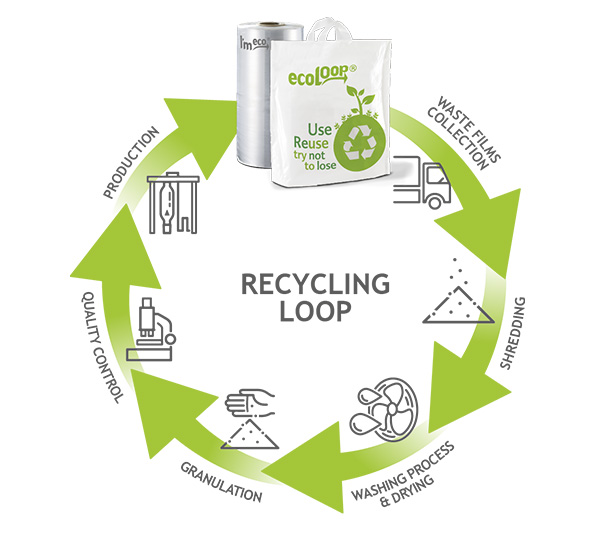
We look for solutions for the use of packaging after it has been used. Even during development we check the technical recyclability of our materials. Our goal is the implementation of closed material loops. Papier-Mettler takes into account the different phases of a product – from manufacture through use to disposal. Since 1992 we have been working continuously on our own recycling concept – in both the paper and plastics sectors. Our approach is based on avoiding waste, reusing materials and recycling raw materials.
Used packaging is a valuable material. Our recycling system enables efficient and predictable disposal. In addition, at Papier-Mettler we process used flexible plastic packaging back into raw materials for new production. We ensure a functioning recycling loop for you.
As early as 1992, the company opened its first recycling plant at its headquarters in Morbach. Since then, the recycling capacity has been continuously expanded. Today, Papier-Mettler has extensive production capacities in Europe. Recycling has a long tradition at Papier-Mettler. The post-consumer recycling (PCR) process requires specialised technical know-how and decades of experience compared with industrial recycling (IR). Papier-Mettler deliberately applies this expertise in the production of ecoLoop bags with recycled content.
Energy Management
Further information on our energy management system can be made available upon request.
*for energy-intensive processes
Download the certificate attachment >here<.
Outstanding commitment
We are partnered with, and promote initiatives committed to environmental and climate protection and in particular support responsible use of plastics and plastic waste. Collaborating on ventures and internal projects with companies and associations in the plastics industry, NGO’s and politicians we hope to achieve our common goals.
Climateline
Optimising our products and processes so that as little energy as possible is required and CO2e emissions are saved – this is one of Papier-Mettler’s main goals.
To additionally support climate protection projects worldwide, we work together with our partner Climateline – an initiative of zukunftswerk eG. On request, we transparently determine the calculated CO2e footprint of your packaging along production and delivery. We also offer the option of financially supporting certified climate protection projects through the purchase of emission reduction certificates.
Papier-Mettler can then obtain an emission reduction certificate by sending a sum of money to Climateline. This money is used to sponsor certified climate protection initiatives.
Waste Free Oceans Initiative

First and foremost is always the responsible handling of resources and products by people. Papier-Mettler supports this together with its retail customers through more than 20 years of experience in recycling and material savings throughout Europe. Whether through public disposal systems or take-back systems in retail – Papier-Mettler has been pursuing the goal of recycling used film waste since the early 1990s.
With modern production facilities and structured environmental, quality and safety management systems, Papier-Mettler meets demanding industry standards. We are continuously working to reduce water and energy consumption and production waste at our company and production sites as far as possible and to optimise our processes taking efficiency and cost-effectiveness into account.
For Papier-Mettler, promoting marine protection is the logical continuation of our environmental commitment and a further contribution to a responsible approach to plastic. Together with other companies in the plastics industry, NGOs and politicians, we want to draw attention to the problem of the growing amounts of waste in the world’s oceans and make a contribution to marine protection.
In order to actively promote the protection of marine habitats, Papier-Mettler joined the Initiative Waste Free Oceans (WFO) in July 2012. In collaboration with European fishermen, their goal is to reduce the disposal of waste at sea and in coastal areas of Europe. The fishermen’s boats are equipped with special nets enabling them haul 2 to 8 tonnes of waste from the sea on each trip. The waste is then sorted and recycled if possible.
At the WFO marine protection and recycling are meaningfully combined, whilst the fishermen benefit from it. You can find out more here.
Product protection
In the public discussion about packaging, the fact that packaging fulfils an important protective function often takes a back seat. However, packaging is very important for our daily lives, the economy and the conservation of resources. It secures our supply of food, medicines, raw materials and all everyday goods.
First of all, packaging gives protection enabling products to be transported and stored securely. It also safeguards hygiene and quality and ensures a product is intact.
Too much packaging leads to a waste of resources. However, if packaging is reduced to the point that the product is “under-packaged”, the risk increases that the product will be damaged or spoil and have to be disposed of. Looking at the entire life cycle of a packaged product, the packaged product causes many times more loss of resources if it is damaged than its packaging does. If the goods can no longer be used because savings were made on the protection provided by the packaging, the overall damage is significantly greater. Needs-based packaging therefore makes a significant contribution to avoiding unnecessary product losses.
 Deutsch
 English (UK)
 English (US)
 Español
 Français
 Italiano